HRTech Interview with Emma Lavelle, Chief Operating Officer, UneeQ
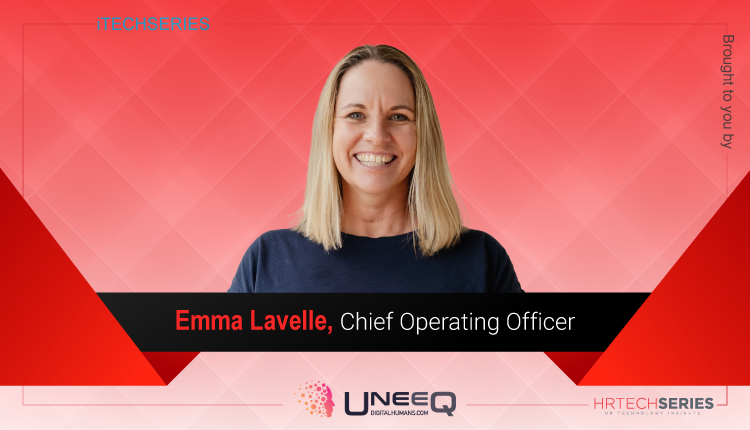
Emma Lavelle, Chief Operating Officer, UneeQ chats about the fundamentals of building AI first organizations in this catch up with HRTech Series:
______
Let’s talk about reskilling employees for AI-augmented workplaces, some proven practices that work?
This is the fastest and most widespread reskilling of the workforce many of us have witnessed in our careers. What a privilege it is to be an HR leader in this historical moment in time.
Organizations evolving well are not viewing reskilling and AI adoption as a project with a start and end date. It is tempting to be impressed by the initial organizational step change from ‘no AI’ to ‘using AI’. But that is just a first step onto a staircase that currently has no upper end in sight. Creating environments for continuous learning is the new competitive advantage. Organizations that are navigating employee reskilling well are building continuous learning into the flow of work, recognizing that workforce development can no longer be separated from day-to-day operations. Continuous learning is now part of everyone’s job. In the age of AI, the climb doesn’t stop.
For HR leaders, one practical recommendation is to look beyond technical skills alone. While AI fluency is increasingly important, the capabilities that create long-term value are deeply and exclusively human: judgment, empathy, critical thinking, creativity, and accountability. The organizations that will see the strongest results are investing in both technical AI proficiency and the human skills that help employees apply AI effectively and responsibly.
I’d also encourage leaders not to overlook the emotional side of reskilling. Employees are navigating real uncertainty about how AI will affect their roles and careers. The companies making the most progress are transparent about how AI is being introduced, involve employees in the process, and position reskilling as an investment in future growth rather than a response to disruption. That approach builds trust and drives much stronger adoption over time.
At UneeQ, we’ve seen that people build confidence with AI not through one-off training sessions, but through ongoing practice, feedback, and experimental learning embedded into everyday work.
Managing Organizational change during AI adoption, what should business heads prioritize?
As the saying goes, “Organizations don’t change, people do.” This continues to be true for AI adoption. Successful AI adoption is a people and cultural transformation, not a technology deployment. Organizations doing this well are embedding this change into broader conversations about culture, ways of working, career development and employee enablement.
Do not delegate AI Adoption change management to a project team. HR Leaders need a seat at the table from the beginning, helping leaders understand not only whether AI is being adopted, but how employees are experiencing that transition.
A lesson for HR leaders isn’t to replicate specific programs, it’s to adopt the operating principles that make change sustainable such as investing heavily in communication, creating meaningful feedback channels, and continuously adapting based on employee experiences. Whilst most people find change exhausting – the challenge facing HR leaders now is to rebrand continuous change into something that is celebrated and embraced across the organizational culture.
Another important lesson is the need to shorten feedback loops. Traditional change management often operates on long waterfall timelines: implement, assess, and adjust months later. AI evolves too fast for this. Organizations that are succeeding have created mechanisms to gather employee feedback frequently and make adjustments in near real time.
Recent examples across the technology sector have reinforced how even organizations at the forefront of AI can struggle when employees lack clarity around vision, career growth, and how AI will change their work. Speed matters, but trust matters more. Employees need to understand not only what is changing, but why it matters and how they fit into the future being created.
I experienced this firsthand while helping develop UneeQ’s AI adoption guiding principles. Like many leaders, I didn’t have all the answers. What I learned was that transparency builds trust. Being open about uncertainty encouraged more honest conversations, stronger participation, and ultimately better outcomes. The organizations managing change most effectively aren’t waiting until everything is figured out before engaging employees; they’re bringing people into the journey as it unfolds.
Building trust is another enabler for successful organizational change. At UneeQ, our research
and the experiences we see through Immersive Training Platform and Digital Human experiences consistently show that people engage more openly when they feel supported rather than judged. The same principle applies inside organizations. Employees are more likely to experiment, learn, and adopt AI when they feel safe asking questions, making mistakes, and sharing concerns.
How is AI changing employee expectations and workplaces?
Employees are both expectant and uncertain about AI. They’re eager to eliminate repetitive work and become more productive, but they’re also seeking clarity on how their roles will evolve. Employees need and want clarity on when and how they should be using AI tools and expect a new definition of what success looks like in their role. Leaders should invest effort and time in articulating this clarity – even when it means acknowledging what they don’t yet know. And there’s a chasm of difference between providing clarity and projecting false certainty. No one has a finished AI adoption playbook, it doesn’t exist. This is not a time of certainty, this is a time of change, innovation and uncertainty.
Increasingly, what we’re hearing from CHROs across industries is that employee experience is becoming inseparable from AI experience. Employees now expect the same level of personalization, responsiveness, and support at work that they experience with AI-powered tools in other parts of their lives.
CHROs are increasingly being asked to lead conversations that extend way beyond traditional HR responsibilities. Discussions about workforce transformation, career mobility, and the future of work are now central topics.
I believe the leaders most effective right now, are not those projecting confidence and certainty, they are those who feel and acknowledge all the same uncertainty as everyone else and also choose to stay open-minded, to keep asking questions, to learn new tools, new ways of working, and new ways of thinking and in demonstrating all of this, become part of creating the future workforce.
At UneeQ, we’ve seen that people engage more openly, learn more effectively, and build confidence faster when they feel psychologically safe and supported. That same principle increasingly applies to AI adoption inside organizations.
Catch more HRTech Insights: HRTech Interview With Hari Kolam, CEO and Co-founder of Findem: Featuring Findem’s GliderAI
About the shift towards AI-assisted and hybrid human-AI teams?
I don’t believe there is a balance to be found between automation and human employees. This is not a right or wrong decision, it is simply a lot of choices and tradeoffs – and that’s exactly why we need people with judgment and critical thinking.
Automation will get you speed and cost reduction, but the quality will be only as good as the inputs and system design. Human led activities are likely higher cost, more prone to variation, but can also use intuition to flex in the moment, know when to break the rules or vary the script based on a nuanced human need.
Humans provide context, empathy, accountability, and the ability to adapt when situations don’t fit neatly into predefined rules or workflows.
My advice to organizations: be intentional about what you automate and keep listening to what your employees and customers are saying and doing. These are your greatest indicators and feedback on your hybrid human/AI mix.
At UneeQ, we build digital humans designed to augment human connection, not replace it. Our belief is that the best AI experiences create more space for uniquely human work, relationship-building, creativity, coaching and decision-making, rather than less.
And always remember that it is not a fixed destination, keep adapting based on data and emerging tools. The organizations getting this right treat hybrid human-AI teams as an evolving practice or listening, learning, and adapting over time.
What HR leaders should prioritize as work itself evolves?
One of the biggest shifts in hiring is moving beyond static skill matching and placing greater emphasis on ‘exclusively human’ competencies.
One of the benefits emerging from AI Adoption within our organization has been capability expansion – employees are now able to do tasks, such as coding in a new programming language, previously impossible without technical training. Specific skills and knowledge, previously only accessible via people, are being commoditized and democratized by AI tools.
So what does that mean for hiring and the types of employees organizations should be looking for? In such rapid change, organizations need employees who are hungry to learn, adapt, and apply new technologies as work changes. I believe, the ‘exclusively human’ qualities that have always been valuable, but even more so now are curiosity, judgment, integrity, critical thinking, compassion, and a willingness to embrace change.
That has implications for both hiring and reskilling. Rather than focusing primarily on current technical capabilities, organizations should be equally evaluating how candidates learn, make decisions, solve problems, and navigate ambiguity. Those traits could be stronger indicators of long-term success in an AI-enabled workplace than experience with any specific tool.
On the reskilling side, do everything you can to eliminate the abstraction transfer problem, which is the gap between what employees learn in training and what they can actually apply in their day-to-day work. Reskilling training should emphasize hands-on practice, coaching, simulations, and real-world application. People build confidence and capability through experience, not just information.
At UneeQ, we’ve tackled that problem head on and seen how immersive, conversational learning environments can accelerate skill development by actively engaging employees rather than passively consuming content. Through our Immersive Training Platform, we see that experimental learning helps people build both technical confidence and the human-centered skills needed to thrive alongside AI. As AI becomes more embedded in work, organizations will need to create more opportunities for experiential learning that help people build both technical confidence and human-centered skills.
I would also encourage HR leaders not to overlook internal mobility as a reskilling strategy. The organizations best positioned for long-term success will be those that can identify existing talent, develop new capabilities from within, and help employees transition into emerging roles as work evolves.
Read More on Hrtech : Why SWIFT is Too Slow for Your Global Workforce?
[To share your insights with us, please write to psen@itechseries.com ]

UneeQ is an enterprise AI company headquartered in Austin, Texas, that specializes in creating lifelike, emotionally intelligent “digital humans” for customer service and immersive training.
Emma Lavelle is the Chief Operating Officer at UneeQ. Since March 2020, she has overseen operations, ensuring the seamless delivery of AI-powered customer experience solutions that UneeQ has to offer.
The post HRTech Interview with Emma Lavelle, Chief Operating Officer, UneeQ appeared first on TecHR.


Comments
Post a Comment